Staking Modules Updates
Community Staking Module

Two Years of CSM: Permissionless Ethereum Validation at Scale
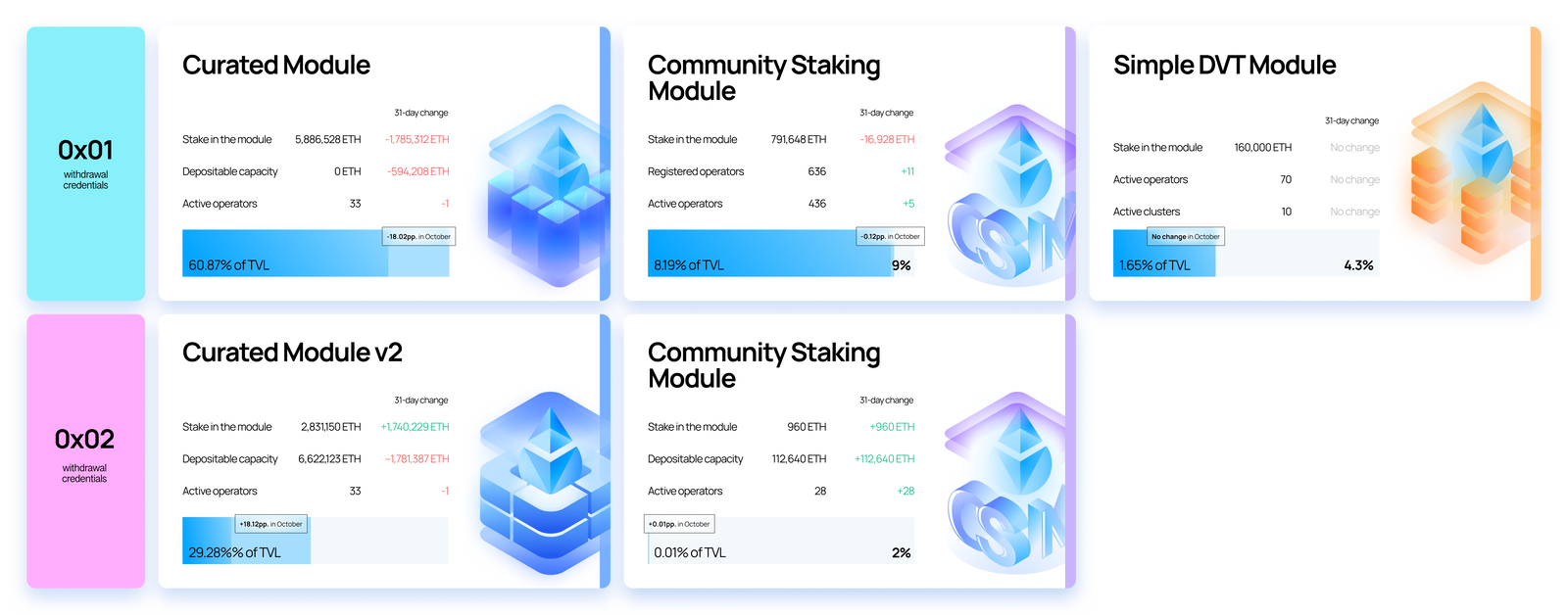
October marked two years since the Community Staking Module (CSM) launched on Ethereum mainnet. Over this period, CSM has attracted strong interest from the Ethereum staking community, with more than 600 Node Operators registered and ~440 actively validating nearly 800k ETH of Lido Core TVL.
This represents approximately 1.8% of all network-staked ETH with strong operational performance of a 99.4% participation rate and 99.3% correctness over the past 90 days, according to Rated Explorer. Since launch, CSM validators have proposed 42,654 blocks and earned 18k+ ETH in total rewards.
Following two major upgrades and the recent introduction of support for 0x02 withdrawal credentials, CSM has evolved beyond its original role of enabling permissionless validation in the Lido protocol. Its codebase also served as the technical foundation for Curated Module v2 (CMv2), extending its impact across the protocol's staking infrastructure.
CSM has paved the way for greater operator diversity across the Lido validator set, doubling the total number of unique Lido Node Operators (NOs) and advancing Ethereum's decentralization. Through the ICS framework, it has also expanded validation access for independent operators, with over 400 approved applications qualifying for enhanced staking parameters.
From expanding permissionless access to supporting the next generation of staking modules, CSM has become an important part of Lido's ongoing efforts to foster a more decentralized, accessible, and resilient Ethereum validator ecosystem.
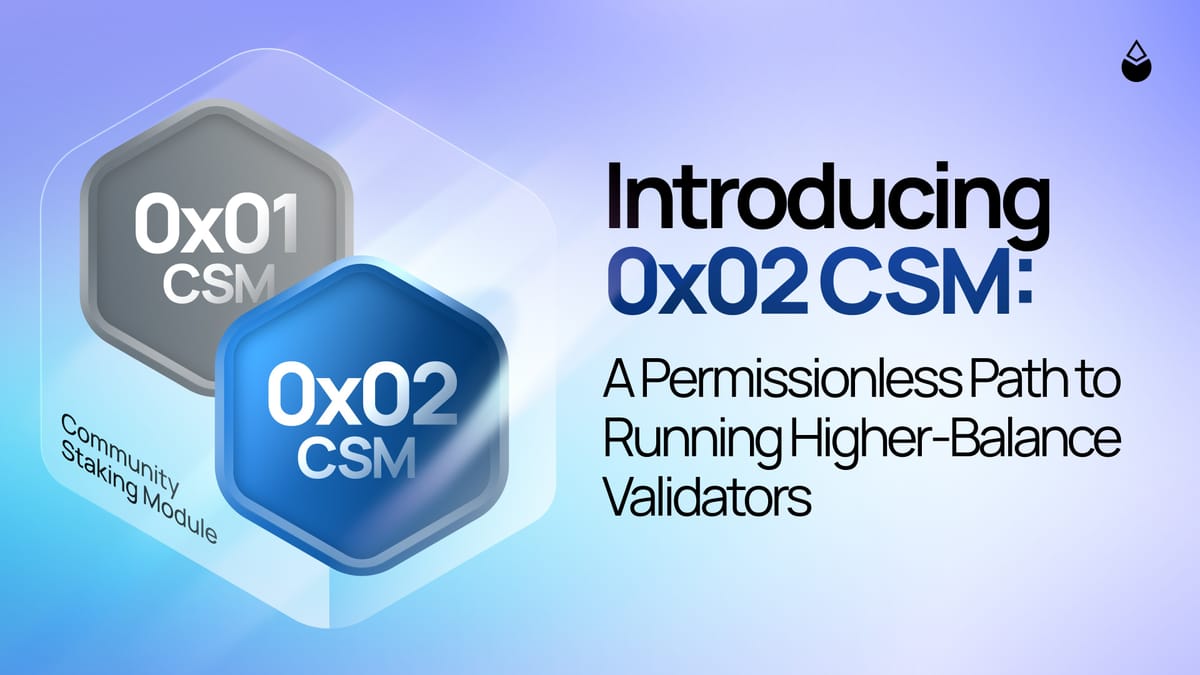
0x02 CSM Launch
Following a successful public testnet, approval through Lido DAO on-chain Vote #206, and completion of the Dual Governance review, 0x02 CSM officially launched on Ethereum mainnet in October.
Complementing the existing CSM for 32 ETH validators, the new module introduces a permissionless pathway for running validators with maximum effective balances of up to 2,048 ETH through Lido Core, expanding opportunities for independent operators to participate in Ethereum validation at scale.

0x02 CSM Stake Allocation
The module launched with an initial stake share limit of 0.01% of Lido Core TVL to ensure that the new module can receive stake without disrupting allocation across other modules or broader protocol operations.
Early demand was huge — the first operators submitted 30 available validator keys for initial seed deposits within minutes of launch, with another 54 keys waiting in the protocol deposit queue. All 30 submitted keys have since received their seed deposits and are awaiting activation through Ethereum's validator entry queue.
Once these first validators become active, the CSM Committee is expected to propose gradual increases to the module's stake share limit through Easy Track in increments of 0.5 percentage points (pp.), up to 2% of Lido Core TVL. The combined allocation of the existing 0x01 CSM and the new 0x02 instance would remain below the proposed 20% ceiling.
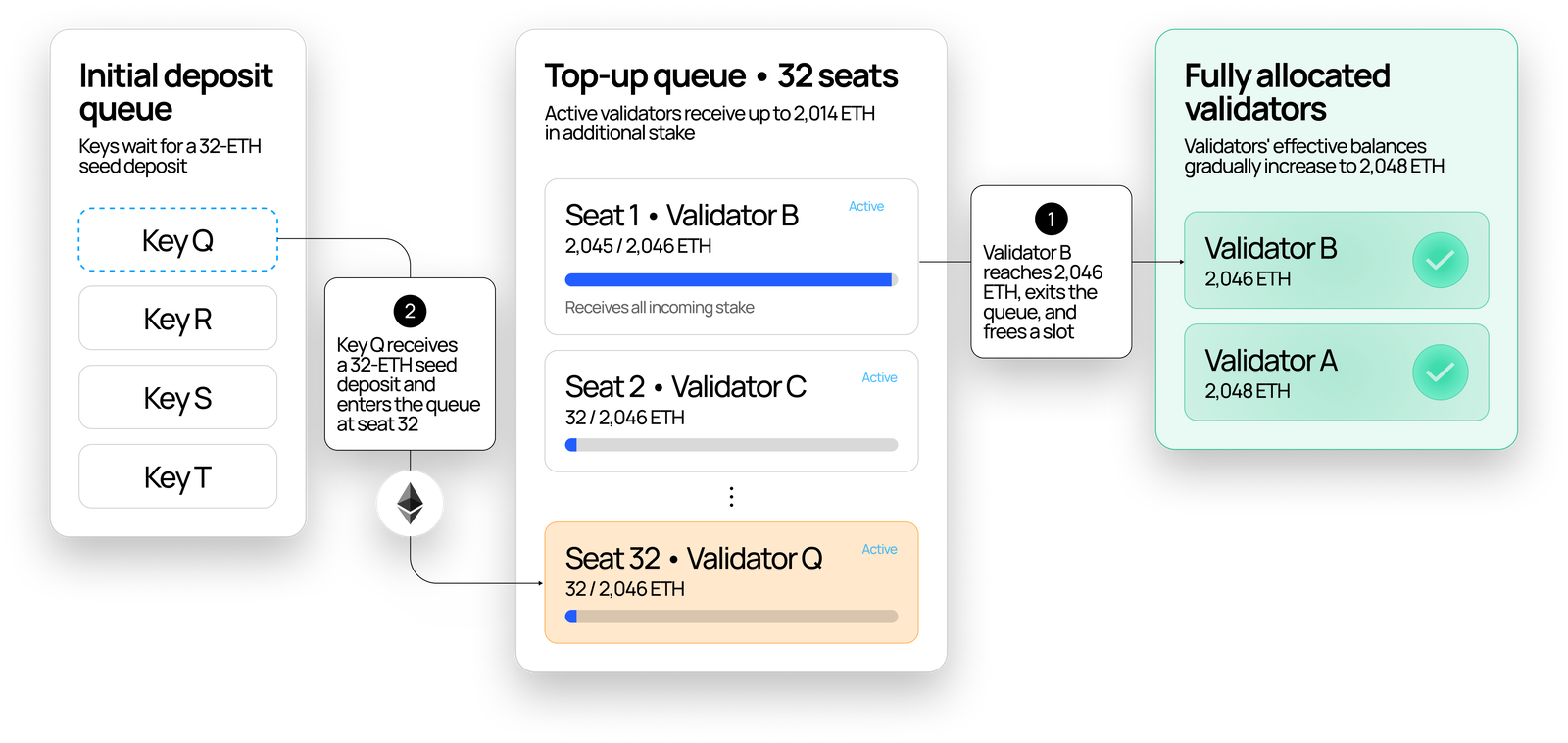
The allocation mechanism is designed to balance new validator activations with top-up deposits. Learn more about the 0x02 CSM allocation mechanism on the Research Forum.
Curated and Curated v2 Modules
30% of Curated Stake Consolidated
October saw progress in the migration to the CMv2, with Lido Curated Node Operators consolidating over 1.6m ETH from the legacy Curated Module (CMv1) into 0x02 validators in CMv2 during this month.
By the end of the month, 2.6m+ ETH, or 30% of Curated stake, had been migrated. These also contributed to the growing adoption of compounding validators across Ethereum, increasing their network-wide share above 40%.
Beyond the migration itself, consolidating legacy 0x01 validators into higher-balance ones helps reduce Ethereum's active validator count and associated consensus-layer overhead, supporting greater network efficiency.
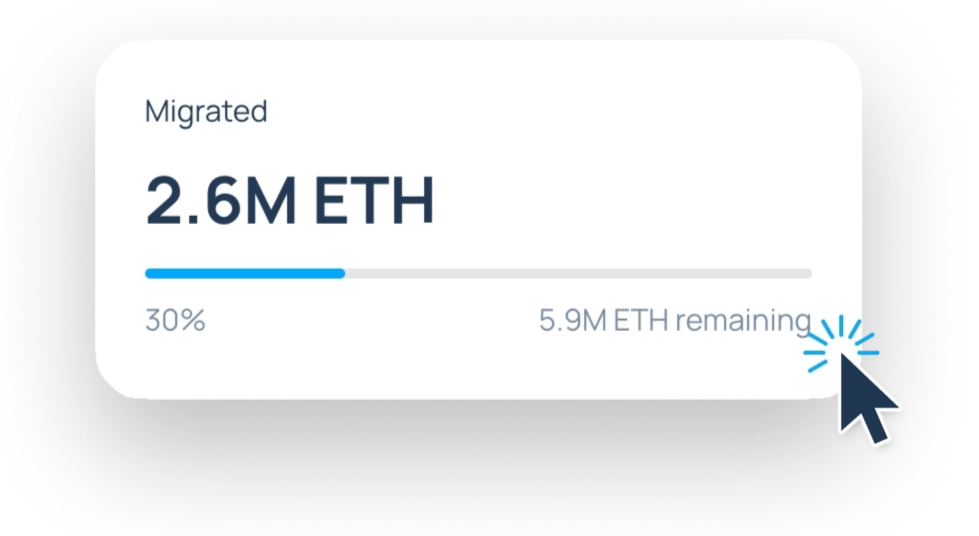
Track the latest migration progress through the consolidation-ui.lido.fi/protocol/operators
mump2p PERCH Testing Results
Optimum published the results of its one-month mump2p testing on Hoodi, conducted between September 17 and October 15 with six Lido Curated NOs: P2P, Rocklogic, Ebunker, Stakefish, HashKey Cloud, and Stakely.
Throughout the testing period, the mump2p gateway ran alongside the operators' existing setups without reported incidents. According to Optimum's findings, the test demonstrated promising improvements in block propagation and validator performance. Read the full report in Optimum's Research Forum update.
What’s next?
Lido contributors are currently reviewing Optimum's report to determine potential next steps. In the meantime, participating Curated operators can continue running their mump2p gateways on Hoodi, with no additional action required at this stage.
Simple DVT Module
Lido x Obol
5 Super Clusters are active on mainnet, running 500 validators each
Lido x SSV
5 Super Clusters are active on mainnet, running 500 validators each
Proposals to Watch
Several important proposals are currently under discussion, addressing developments at both the Lido protocol and Ethereum network levels. Here's what Node Operators and Lido community should keep an eye on.
Updated MEV Policy for Lido Proposal
Ethereum's upcoming enshrined Proposer-Builder Separation (ePBS) introduces new mechanisms for validators to participate in the block-building markets, prompting a proposed update to Lido's existing MEV Policy that reflects both trustless and trusted mechanisms.
The proposal aims to preserve its core principles while adapting them to the ePBS environment: maximizing rewards for stakers, supporting open and competitive block-building markets, and ensuring that operators neither favor particular builders nor withhold MEV rewards.
Read the proposal and share your feedback on the Lido Research Forum. The proposal is set to be submitted for the DAO consideration in the December voting slot, ahead of the upcoming mainnet upgrade in 2027:


Lido Lend: Feature Highlights, Technical Specification and Committees
Proposal by proposal, Lido contributors continue to unveil the design of Lido Lend, a proposed decentralized lending market built around a security-first approach, with safeguards and utilities to benefit both lenders and borrowers.
The latest posts provide a deeper look into Lido Lend's architecture and proposed mechanisms, including Fallback Exits, the Guardian Security Council, Turbulence Controls, technical specifications, and the committees envisioned to support the market's operations and security.
Explore the proposals and join the discussion on the Research Forum:
Learn More
Want to understand the motivation behind Lido Lend?
Watch this clip from October's Lido Poolside community call, where contributors explain the rationale behind the proposed lending market and the problems it aims to address.
EIP-8148 Considered for Inclusion into Hegotá
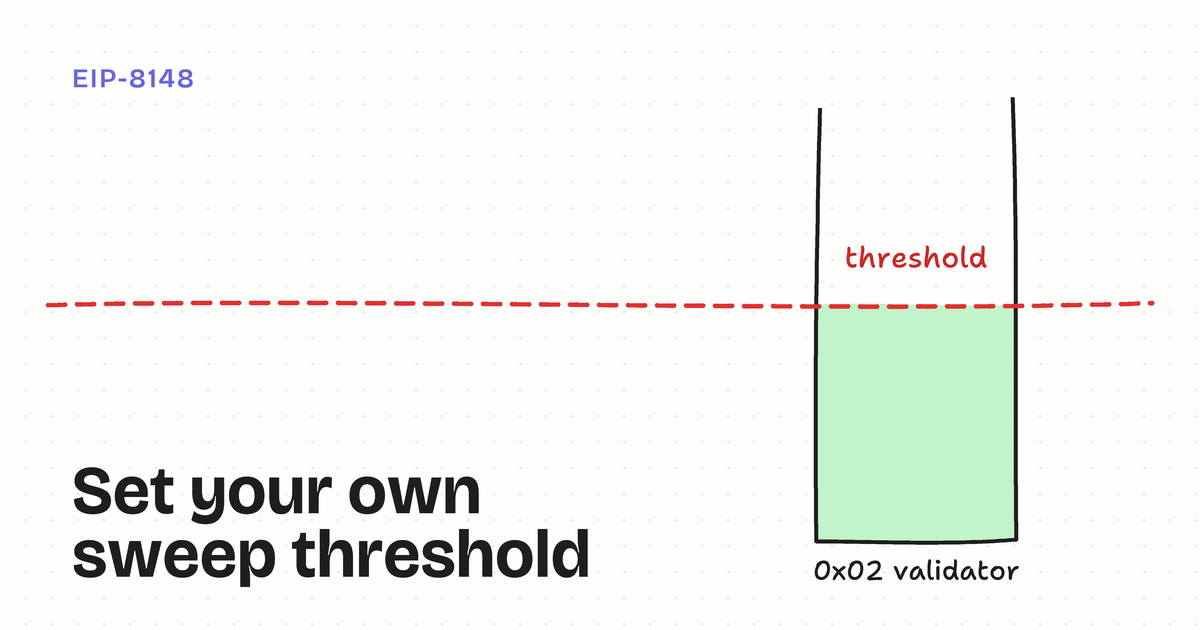
EIP-8148 introduces support for the custom reward sweep threshold (custom validator size) for 0x02 validators. Rather than waiting until their validators reach the maximum effective balance of 2,048 ETH, operators can set a desirable size for their validator and receive rewards as they used to with 0x01 validators. This would give operators greater flexibility and control in managing staking rewards, particularly benefiting independent and community stakers who may be sensitive to long reward collection periods.
During the last October's All Core Devs - Consensus (ACDC) #190 call, EIP-8148 received Considered for Inclusion (CFI) status for Hegotá, which means that the proposal was shortlisted for further evaluation and testing on devnets ahead of the hard fork.
This advances EIP-8148 to the next stage of the next upgrade consideration process, but it still remains a draft, and its inclusion in Hegotá is not guaranteed.

Node Operator Community
Lido Poolside
October edition of the Lido Poolside community call brought together industry experts from Lionscraft, Ethereum Institutional, EY Australia, and TheDAO for a panel discussion on strengthening Ethereum validator operations through the newly launched Validator Operations Standard (ValOS).
The call also celebrated the mainnet launch of 0x02 CSM with a special community giveaway.
On top of that, contributors took a closer look at Lido Lend, exploring the motivation, vision and main features behind the proposed security-first decentralized lending market.
Catch up on all three discussions in the full 1-hour recording on YouTube.
Q3 2026 Community Lifeguards Initiative Report
In Q3 2026, the Community Lifeguards Initiative (CLI) Committee provided a $1,000 grant to support an Ethereum validator meetup in Prague, organized as part of the community's Road to ETHPrague. The meetup aims to bring together Ethereum builders, stakers, and community members to exchange ideas, share knowledge, and strengthen Prague's local Ethereum ecosystem.
In Prague on Thursday, November 26?
Join the community for an evening of knowledge-sharing, open discussions, and networking with fellow Ethereum enthusiasts and staking professionals. Register for the event.
About Community Staking Grants
The Community Staking Grants Committee supports grassroots initiatives that benefit independent node operators, home stakers, community operators, and the broader Ethereum staking ecosystem, helping turn community-driven ideas into real-life contributions.
Have an idea that could make Ethereum staking more accessible, decentralized, or resilient?
If your idea falls within any of these categories — Community Resources, Community Event-Related, Research, Integrations & Analytics — it could be eligible for support.
Explore the application guidelines and submission process, and bring your idea forward to help strengthen Ethereum's independent validator community.
Glamsterdam on Hoodi Postponed
Ethereum core developers postponed the Glamsterdam upgrade on Hoodi, originally scheduled for October 26, 2026. A new activation date has yet to be announced.
This testnet upgrade delay does not affect the mainnet Lido protocol.
As Lido's Hoodi contracts had already been upgraded in preparation for the original activation date, Lido contributors initiated and executed a Hoodi rollback of the fork-specific changes, ensuring the testnet remains operational until a new upgrade date is confirmed, as well as coordinating that with the broader Ethereum ecosystem.
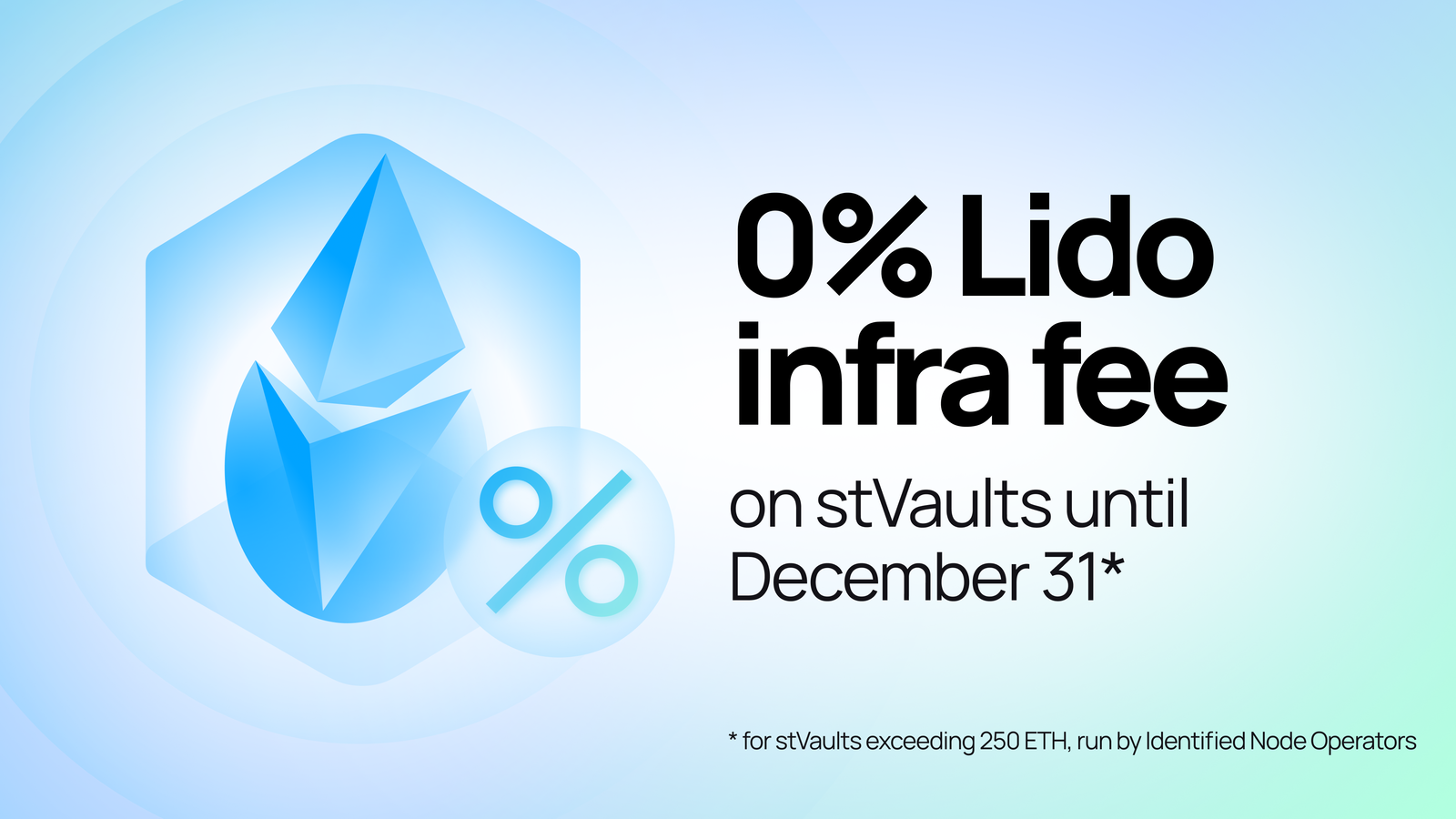
Lido V3 Early Adopters Campaign Extended
While Ethereum’s validator entry queue has shortened significantly, activation times remain relatively long.
The stVaults Committee extended the Early Adopters Campaign till the end of 2026, maintaining a 0% Lido
Infrastructure Fee for all qualifying stVaults (eligibility criteria unchanged).
If you are considering building a custom staking product, or a private staking vault, start building today, or contact the stVaults team to start a conversation.